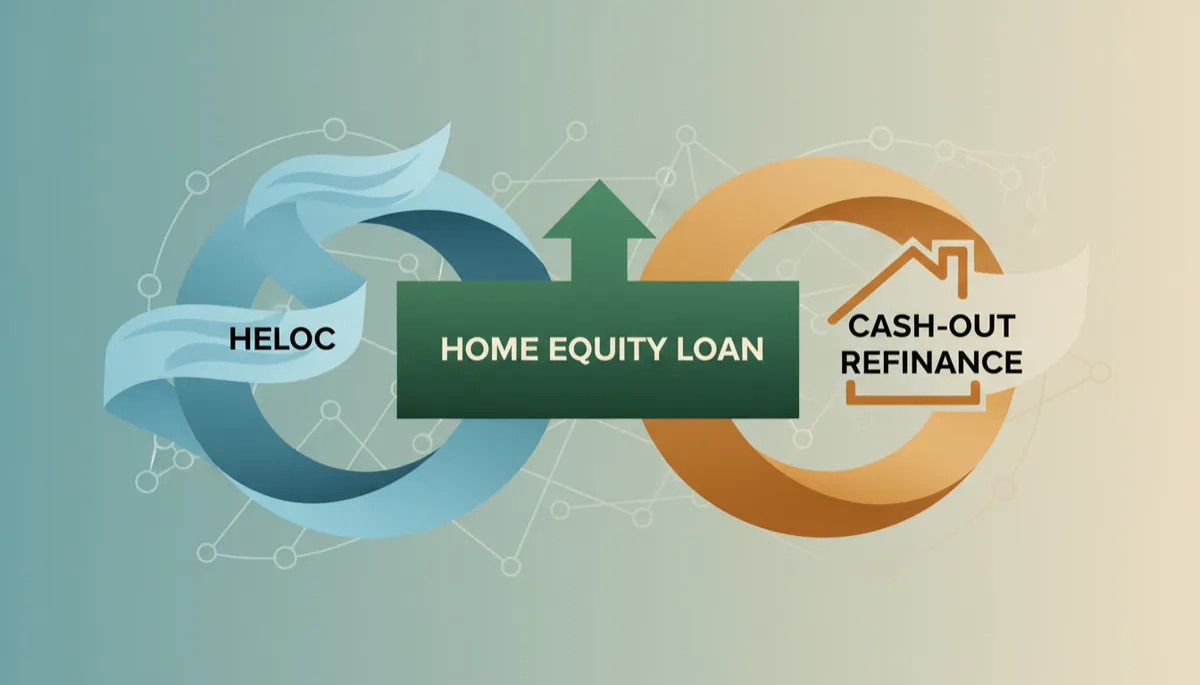
HELOC vs Home Equity Loan vs Cash-Out Refinance
Home Equity, Mortgages, Personal Finance
HELOC vs. Home Equity Loan vs. Cash-Out Refinance: What’s the Difference?
If you’ve built up equity in your home, you’re sitting on a powerful financial tool. But should you tap it with a HELOC, a home equity loan, or a cash-out refinance? Understanding the differences can save you thousands of dollars and a lot of stress.
First, a Quick Refresher: What Is Home Equity?
Home equity is the difference between your home’s current market value and what you still owe on your mortgage. For example, if your home is worth $400,000 and your mortgage balance is $260,000, you have $140,000 in equity. Lenders typically let you borrow a portion of that equity, often up to 80–90%, depending on your credit, income, and overall financial profile.
What Is a HELOC?
A Home Equity Line of Credit (HELOC) works a bit like a credit card backed by your home. The lender approves you for a maximum line of credit, and you can borrow, repay, and borrow again during a set “draw period,” often 5–10 years. You pay interest only on what you actually use, not the full line amount.
Most HELOCs have variable interest rates. As of early October 2026, national HELOC averages generally hover around 7.1%–7.3%, according to Bankrate and other tracking services, with some lenders advertising ranges roughly from 4% up to the low teens. Credit unions often come in lower, with a median rate near 6.5% and some as low as 4% for highly qualified borrowers. Your actual rate will depend on your credit score, income, equity, and the lender’s margin over the prime rate.
💡 Pro Tip: Because HELOC rates are usually variable, your payment can rise if overall interest rates go up. Make sure your budget can handle that risk.
Best for: Ongoing or unpredictable expenses, like multi-stage home renovations, tuition over several years, or a flexible emergency fund.
Key features: Revolving line of credit, interest-only payments during draw period, variable rate, closing costs that are often lower than a full refinance.
What Is a Home Equity Loan?
A home equity loan is sometimes called a “second mortgage.” Instead of a line of credit, you receive a single lump sum up front and repay it over a fixed term, usually between 5 and 30 years, through equal monthly payments. Unlike most HELOCs, home equity loans almost always have a fixed interest rate, so your payment stays the same for the life of the loan.
Exact rates in 2026 vary by lender, market conditions, and your credit profile, but they generally track broader interest rate trends and are often comparable to, or slightly higher than, first-mortgage rates. Because the rate is fixed, a home equity loan can be easier to plan around than a variable-rate HELOC, even if the starting rate is a bit higher.
Best for: One-time, known costs such as a major home improvement project, medical bill, or paying off high-interest credit cards in a single sweep.
Key features: Lump-sum funding, fixed rate, predictable monthly payment, separate from your existing mortgage.

Seeing all three equity options side by side makes trade-offs much easier to understand.
What Is a Cash-Out Refinance?
A cash-out refinance replaces your existing mortgage with a new, larger one. You use part of the new loan to pay off your old mortgage, and you receive the difference in cash. For example, if you owe $220,000 on your current loan and refinance into a $280,000 mortgage, you might receive about $60,000 (minus closing costs) at closing.
With a cash-out refi, you’re not adding a second loan; you’re replacing your main mortgage. Interest rates are usually similar to standard refinance rates for your credit tier, and terms commonly run 15 to 30 years. You’ll pay full mortgage-style closing costs—appraisal, title, lender fees—so this option often makes the most sense when you’re borrowing a larger amount or can significantly improve your main mortgage rate or terms at the same time.
Best for: Homeowners who want a large amount of cash and also want to change their main mortgage (for example, moving from an adjustable to a fixed rate, or extending the term to lower monthly payments).
Key features: New first mortgage, lump-sum cash, closing costs similar to a standard refinance, potentially lower rate than credit cards or personal loans.
HELOC vs. Home Equity Loan vs. Cash-Out Refinance: Key Differences
All three options let you turn equity into usable money, but they differ in how you borrow, how you repay, and how much risk you take on. Here’s how to think about the comparison in plain language:
How you receive funds HELOC: Flexible, draw-as-needed line of credit. Home equity loan: One lump sum. Cash-out refi: One lump sum, tied to a brand-new mortgage.
Interest rate type HELOC: Usually variable, can rise or fall over time. Home equity loan: Typically fixed, predictable payment. Cash-out refi: Usually fixed (though adjustable options exist), full mortgage amortization.
Impact on your existing mortgage HELOC & home equity loan: Sit on top of your current mortgage as a second loan. Cash-out refi: Replaces your existing mortgage entirely.
Costs and fees HELOC & home equity loan: Generally lower closing costs; sometimes promotional “no closing cost” offers. Cash-out refi: Full refinance closing costs, which can run into the thousands of dollars.
How to Choose the Right Option for You
To decide between a HELOC, a home equity loan, and a cash-out refinance, start with three questions:
Do you need flexibility or a fixed amount? If your costs will come in stages or may change, a HELOC’s flexibility is valuable. If you know you need exactly $40,000 for a kitchen remodel, a home equity loan or cash-out refi may be cleaner.
Are you happy with your current mortgage? If you already have a great rate and term, adding a HELOC or home equity loan lets you keep it. If your current mortgage rate is high or your loan type doesn’t fit your goals, a cash-out refinance could improve your overall situation while unlocking cash.
How comfortable are you with variable rates? If rising payments would keep you up at night, lean toward fixed-rate options: a home equity loan or a fixed-rate cash-out refinance. If you can handle some rate movement and want maximum flexibility, a HELOC can work well.
📌 Key Takeaway: All three choices put your home on the line. No matter which you choose, borrow only what you truly need and have a clear plan for repayment.
Finally, compare offers from multiple lenders—including local credit unions and national banks—and request personalized quotes rather than relying only on advertised “teaser” rates. A brief conversation with a trusted mortgage professional or financial advisor can help you match the right equity tool to your goals, whether that’s renovating your home, consolidating debt, or funding a major life expense while keeping your long-term financial health on track.
Still have questions? Let's schedule a quick 15 minute call to discuss your needs https://calendly.com/bnhre/new-meeting.
Get your COMPLIMENTARY Home Valuation and Home Selling Guide at timbeary.realtor